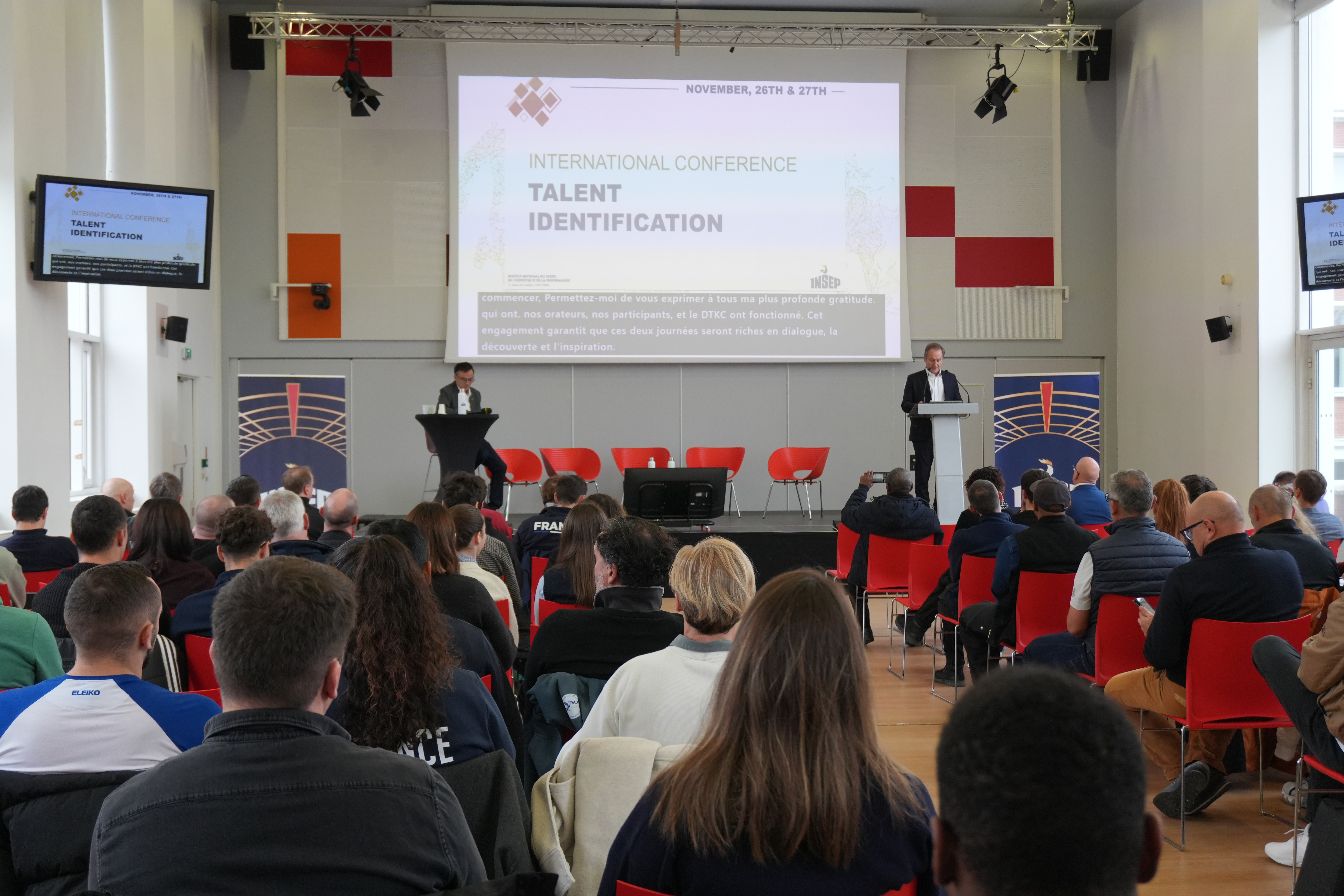
De la conférence internationale « Talent identification » vers la capitalisation d’idées structurantes
Mots-clés :
international, jeune talent, conférence, réussite, potentiel, performance durable, formationRésumé
À l’issue de la conférence internationale « Talent Identification » organisée à l’INSEP, un message fort se dégage : la réussite sportive ne repose pas uniquement sur la détection précoce des meilleurs performeurs, mais sur la capacité à accompagner durablement les potentiels. Les experts réunis ont mis en lumière les limites des critères classiques de sélection chez les jeunes et l’importance de mieux prendre en compte les rythmes de développement, les parcours individuels et l’environnement de l’athlète. Encadrement, santé, équilibre scolaire, soutien familial, qualité des structures : autant de facteurs déterminants pour transformer un potentiel en performance durable. Cette rencontre ouvre des perspectives concrètes pour repenser les parcours de formation et construire des systèmes plus justes, plus efficaces et plus humains au service de la haute performance.
Références
Brown, T., Cook, R., Gough, L. A., Khawaja, I., McAuley, A. B., et Kelly, A. L. « Exploring the multidimensional characteristics of
selected and non-selected white British and British south asian youth cricketers: An exploratory machine learning approach ». Youth, vol. 4, n° 2, 2024, p. 718‑734.
Brown, T., McAuley, A. B., Khawaja, I., Gough, L. A., et Kelly, A. L. « Talent identification and development in male cricket: A systematic review ». J. Expert., vol. 6, n° 2, 2023, p. 176‑206.
De Larochelambert, Q., et al. « Relative age ef fect in French alpine skiing: Problem and solution ». Journal of Sports Sciences, vol. 40, n° 10, mai 2022, p. 1137‑1148. DOI : 10.1080/02640414.2022.2052428.
Difernand, A., et al. « A survival analysis of dropout among French swimmers ». Frontiers in Sports and Active Living, vol. 7, 2025, p. 1509306. DOI : 10.3389/fspor.2025.1509306.
Difernand, A., et al. « Corrective adjustment methods for relative age effects on French young swimmers’ performances ». PLoS ONE, vol. 18, n° 4, 2023, p. e0283229. DOI : 10.1371/journal. pone.0283229.
Difernand, A., et al. « Relative age effects in track-and-field: Identification and performance rebalancing ». Frontiers in Physiology, vol. 13, 2023. Consulté le 13 février 2023. [En ligne]. Disponible sur : https://www.frontiersin.org/articles/10.3389/fphys.2022.1082174.
Griesinger, A. N., Ehnold, P., Hoffmann, A., et Schlesinger, T. « Integrating scientific recommendations for the development and promotion of junior elite athletes in Germany – an analysis of sports policy documents ». International Journal of Sport Policy and Politics, vol. 17, n° 1, janvier 2025, p. 61‑79. DOI : 10.1080/19406940.2024.2404203.
Güllich, A., Barth, M., Macnamara, B. N., et Hambrick, D. Z. « Quantifying the Extent to Which Successful Juniors and Successful Seniors are Two Disparate Populations: A Systematic Review and Synthesis of Findings ». Sports Medicine, vol. 53, n° 6, juin 2023, p. 1201‑1217. DOI : 10.1007/s40279-023-01840-1.
Hernandez, J., et al. « Improving longitudinal performance assessment of youth soccer players: 10 m sprint percentile curves adapted to biological age ». Science and Medicine in Football, mars 2026, p. 1‑12. DOI : 10.1080/24733938.2026.2643531.
LaPrade, R. F., et al. « AOSSM Early Sport Specialization Consensus Statement ». Orthopaedic Journal of Sports Medicine, vol. 4, n° 4, avril 2016, p. 2325967116644241. DOI : 10.1177/2325967116644241.
Malina , R . M., et al. « Bio-Banding in Youth Sports: Background, Concept, and Application ». Sports Medicine, vol. 49, n° 11, novembre 2019, p. 1671‑1685. DOI : 10.1007/s40279-019-01166-x.
Publiée
Numéro
Rubrique
Catégories
Licence
(c) Copyright Audrey Difernand, Pascale Duché, Claude Karcher, Olivier Maurelli, Quentin de Larochelambert, Adrien Sedeaud (Auteur) 2026

Ce travail est disponible sous licence Creative Commons Attribution - Pas d'Utilisation Commerciale - Pas de Modification 4.0 International.