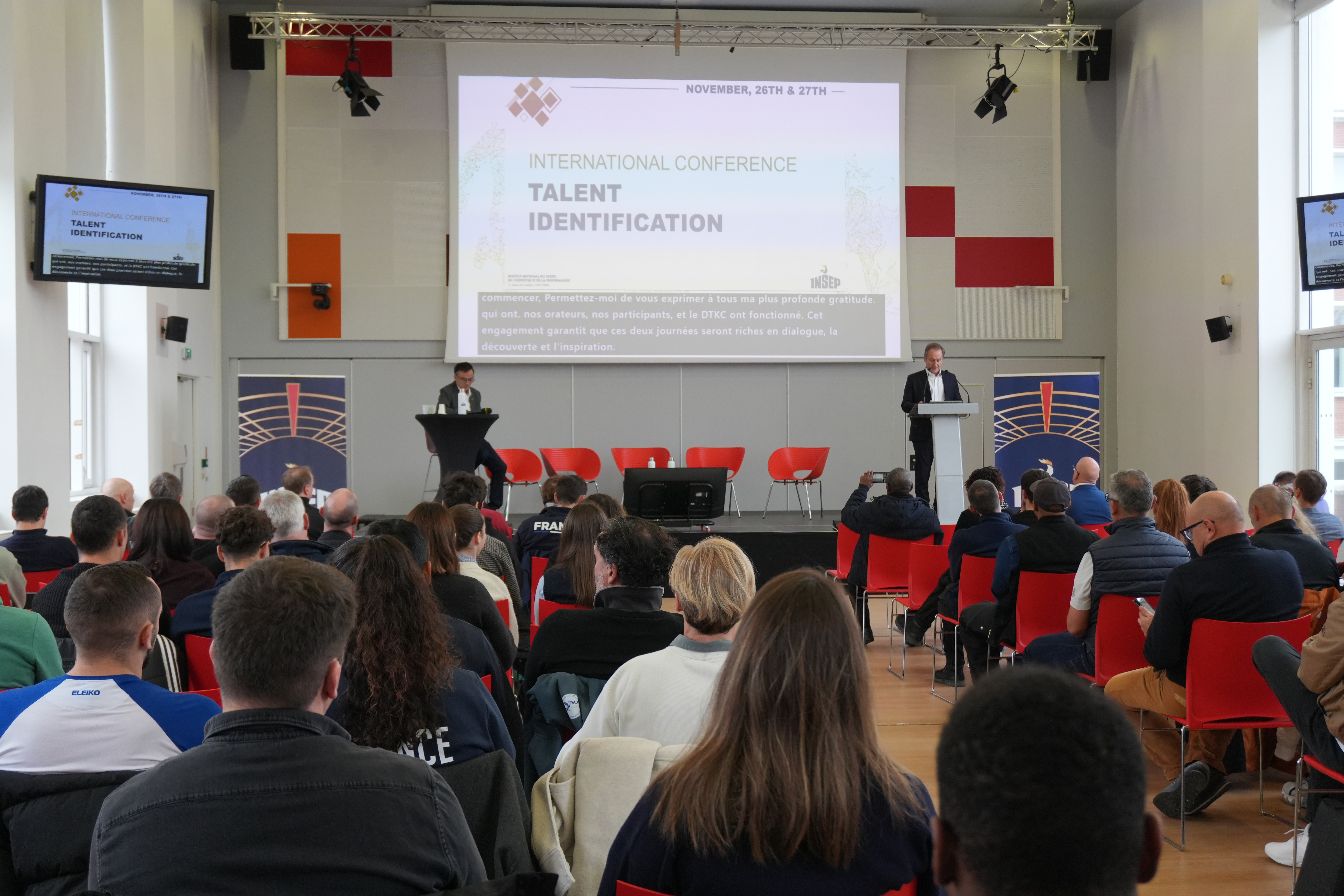
From the international conference on ‘Talent Identification’ to the capitalisation of key ideas
Keywords:
international, young talent, conference, success, potential, sustainable performance, trainingAbstract
Following the international ‘Talent Identification’ conference held at INSEP, a clear message has emerged: sporting success does not depend solely on the early identification of top performers, but on the ability to provide long-term support for promising young athletes. The experts in attendance highlighted the limitations of traditional selection criteria for young people and the importance of taking greater account of development rates, individual pathways and the athlete’s environment. Coaching, health, academic balance, family support and the quality of facilities: all these factors are crucial in transforming potential into sustained performance. This meeting opens up concrete avenues for rethinking training pathways and building fairer, more effective and more humane systems in the service of high performance.
References
Brown, T., Cook, R., Gough, L. A., Khawaja, I., McAuley, A. B., et Kelly, A. L. « Exploring the multidimensional characteristics of
selected and non-selected white British and British south asian youth cricketers: An exploratory machine learning approach ». Youth, vol. 4, n° 2, 2024, p. 718‑734.
Brown, T., McAuley, A. B., Khawaja, I., Gough, L. A., et Kelly, A. L. « Talent identification and development in male cricket: A systematic review ». J. Expert., vol. 6, n° 2, 2023, p. 176‑206.
De Larochelambert, Q., et al. « Relative age ef fect in French alpine skiing: Problem and solution ». Journal of Sports Sciences, vol. 40, n° 10, mai 2022, p. 1137‑1148. DOI : 10.1080/02640414.2022.2052428.
Difernand, A., et al. « A survival analysis of dropout among French swimmers ». Frontiers in Sports and Active Living, vol. 7, 2025, p. 1509306. DOI : 10.3389/fspor.2025.1509306.
Difernand, A., et al. « Corrective adjustment methods for relative age effects on French young swimmers’ performances ». PLoS ONE, vol. 18, n° 4, 2023, p. e0283229. DOI : 10.1371/journal. pone.0283229.
Difernand, A., et al. « Relative age effects in track-and-field: Identification and performance rebalancing ». Frontiers in Physiology, vol. 13, 2023. Consulté le 13 février 2023. [En ligne]. Disponible sur : https://www.frontiersin.org/articles/10.3389/fphys.2022.1082174.
Griesinger, A. N., Ehnold, P., Hoffmann, A., et Schlesinger, T. « Integrating scientific recommendations for the development and promotion of junior elite athletes in Germany – an analysis of sports policy documents ». International Journal of Sport Policy and Politics, vol. 17, n° 1, janvier 2025, p. 61‑79. DOI : 10.1080/19406940.2024.2404203.
Güllich, A., Barth, M., Macnamara, B. N., et Hambrick, D. Z. « Quantifying the Extent to Which Successful Juniors and Successful Seniors are Two Disparate Populations: A Systematic Review and Synthesis of Findings ». Sports Medicine, vol. 53, n° 6, juin 2023, p. 1201‑1217. DOI : 10.1007/s40279-023-01840-1.
Hernandez, J., et al. « Improving longitudinal performance assessment of youth soccer players: 10 m sprint percentile curves adapted to biological age ». Science and Medicine in Football, mars 2026, p. 1‑12. DOI : 10.1080/24733938.2026.2643531.
LaPrade, R. F., et al. « AOSSM Early Sport Specialization Consensus Statement ». Orthopaedic Journal of Sports Medicine, vol. 4, n° 4, avril 2016, p. 2325967116644241. DOI : 10.1177/2325967116644241.
Malina , R . M., et al. « Bio-Banding in Youth Sports: Background, Concept, and Application ». Sports Medicine, vol. 49, n° 11, novembre 2019, p. 1671‑1685. DOI : 10.1007/s40279-019-01166-x.
Downloads
Published
Issue
Section
Categories
License
Copyright (c) 2026 Audrey Difernand, Pascale Duché, Claude Karcher, Olivier Maurelli, Quentin de Larochelambert, Adrien Sedeaud (Auteur)

This work is licensed under a Creative Commons Attribution-NonCommercial-NoDerivatives 4.0 International License.