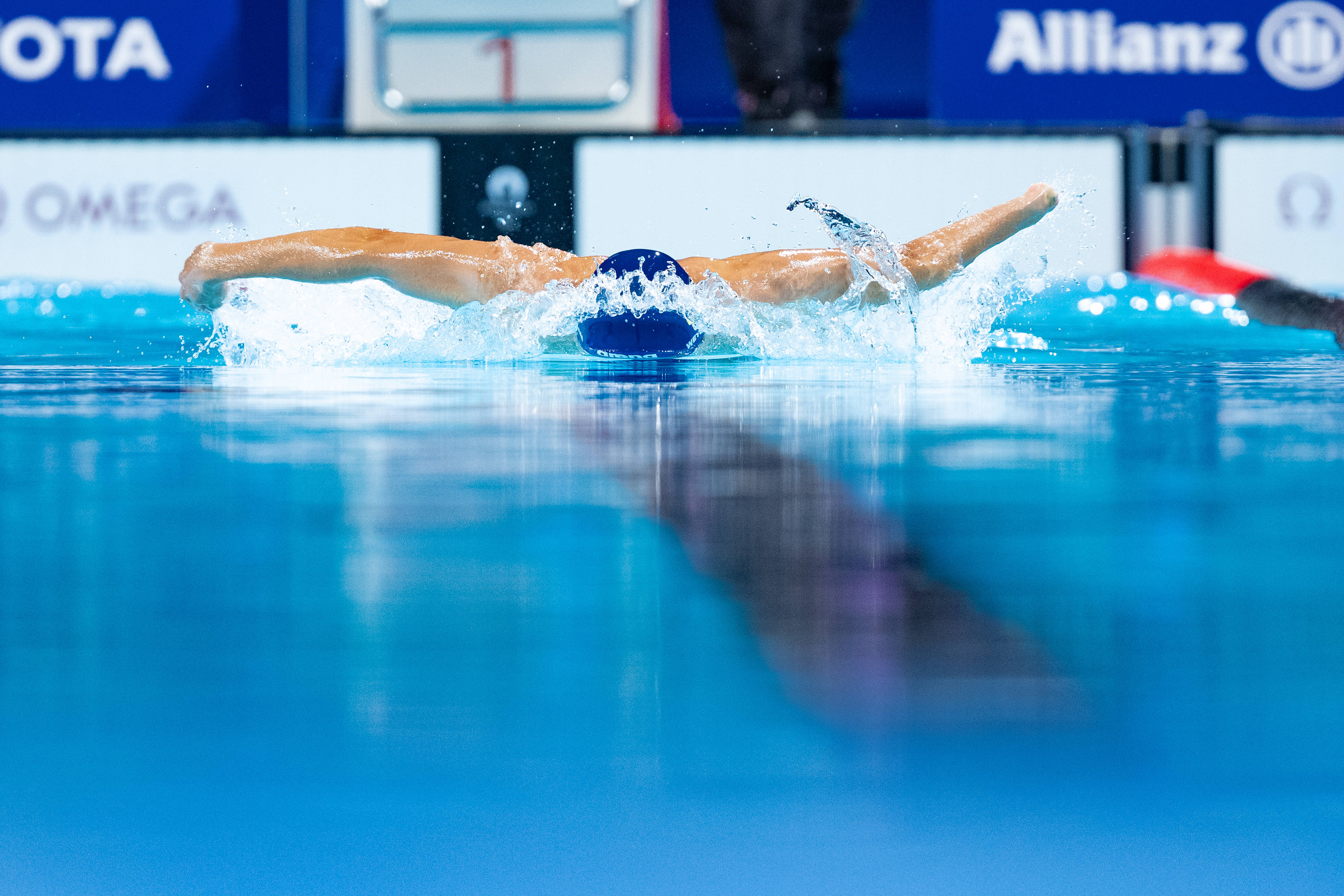
Neptun, an interdisciplinary scientific project to improve performance in swimming and para-swimming
Abstract
The objective of NePTUNE project, “Swimming and Para-swimming: All United with our Elites”, is to provide the French coaches and swimmers with tools and methods (1) to evaluate the key performance factors (stroke rate/stroke length ratio, velocity, water resistance, force, gliding efficiency, motor coordination, etc), (2) to identify the different performance profiles in order to individualize training, (3) to perform physical models in order to optimize performance. To achieve this main objective, we started by analysing competitions, in particular to improve the race management strategies of French swimmers and gain a better understanding of opposing strategies. We then assessed the key factors mentioned above in experimental situations, from which knowledge can be transferred to coaches for monitoring swimmers. To reach these objectives, we built an interdisciplinary project with three axes of research mixing computational science and computer vision, biomechanics, motor control, physiology, physics, fluid mechanics and applied mathematics: (1) Tracking and pacing strategies, (2) Coordination, propulsion and energetics, (3) Water resistance and drafting.
References
Bouvet, A., Pla, R., Delhaye, E., Nicolas, G. et Bideau, N. (2023). Profiles of stroke regulations discriminate between finishing positions during international open water races. Journal of Sports Sciences, 41(13), 1309-1316. https://doi.org/10.1080/02640414.2023.2268902
Carmigniani, R., Seifert, L., Chollet, D. et Clanet, C. (2020). Coordination changes in front-crawl swimming. Proceedings of the Royal Society A: Mathematical, Physical and Engineering Sciences, 476(2237), 20200071–20200071. https://doi.org/10.1098/rspa.2020.0071
Chollet, D. et Seifert, L. (2011). Inter-limb coordination in the four competitive strokes. Dans L. Seifert, D. Chollet et I. Mujika (dir.), The world book of swimming: From science to performance (p. 153-172). Nova Science Publishers.
Kolmogorov, S. V. et Duplishcheva, O. A. (1992). Active drag, useful mechanical power output and hydrodynamic force coefficient in different swimming strokes at maximal velocity. Journal of Biomechanics, 25(3), 311-318. https://doi.org/10.1016/0021-9290(92)90028-Y
Regaieg, M. A., Létocart, A. J., Bosche, J., Seifert, L. et Guignard, B. (2023). Automatic detection of key points of the cycle to assess upper limb coordination in front crawl: effect of swimming speed and impairment. IEEE Sensors Journal, 23(16), 17979-17989. https://doi.org/10.1109/JSEN.2023.3290648
Schnitzler, C., Seifert, L., Alberty, M. et Chollet, D. (2010). Hip velocity and arm coordination in front crawl swimming. International Journal of Sports Medicine, 31(12), 875-881. https://doi.org/10.1055/s-0030-1265149
Seifert, L., Létocart, A., Guignard, B. et Regaieg, M. A. (2024). Effect of breathing conditions on relationships between impairment, breathing laterality and coordination symmetry in elite para swimmers. Scientific Reports, 14(1), 6456. https://doi.org/10.1038/s41598-024-56872-y
Seifert, L., Toussaint, H. M., Alberty, M., Schnitzler, C. et Chollet, D. (2010). Arm coordination, power, and swim efficiency in national and regional front crawl swimmers. Human Movement Science, 29(3), 426-439. https://doi.org/10.1016/j.humov.2009.11.003
Simbaña Escobar, D., Hellard, P., Pyne, D. B. et Seifert, L. (2018a). Functional role of movement and performance variability: adaptation of front crawl swimmers to competitive swimming constraints. Journal of Applied Biomechanics, 34(1), 53-64. https://doi.org/10.1123/jab.2017-0022
Simbaña-Escobar, D., Hellard, P. et Seifert, L. (2018b). Modelling stroking parameters in competitive sprint swimming: Understanding inter- and intra-lap variability to assess pacing management. Human Movement Science, 61, 219-230. https://doi.org/10.1016/j.humov.2018.08.002
Simbaña‐Escobar, D., Hellard, P. et Seifert, L. (2020). Influence of stroke rate on coordination and sprint performance in elite male and female swimmers. Scandinavian Journal of Medicine & Science in Sports, 30(11), 2078-2091. https://doi.org/10.1111/sms.13786
Takagi, H., Shimizu, Y. et Kodan, N. (1999). A Hydrodynamic Study of Active Drag in Swimming. JSME International Journal Series B, 42(2), 171-177. https://doi.org/10.1299/jsmeb.42.171
Vilas Boas, J. P., Fernandes, R. J. et Barbosa, T. (2011). Intra-cyclic velocity variations, swimming economy, performance, and training in swimming. Dans L. Seifert, D. Chollet et I. Mujika (dir.), The world book of swimming: From science to performance (p. 119-134). Nova Science Publishers.
Downloads
Published
License

This work is licensed under a Creative Commons Attribution-NonCommercial-NoDerivatives 4.0 International License.